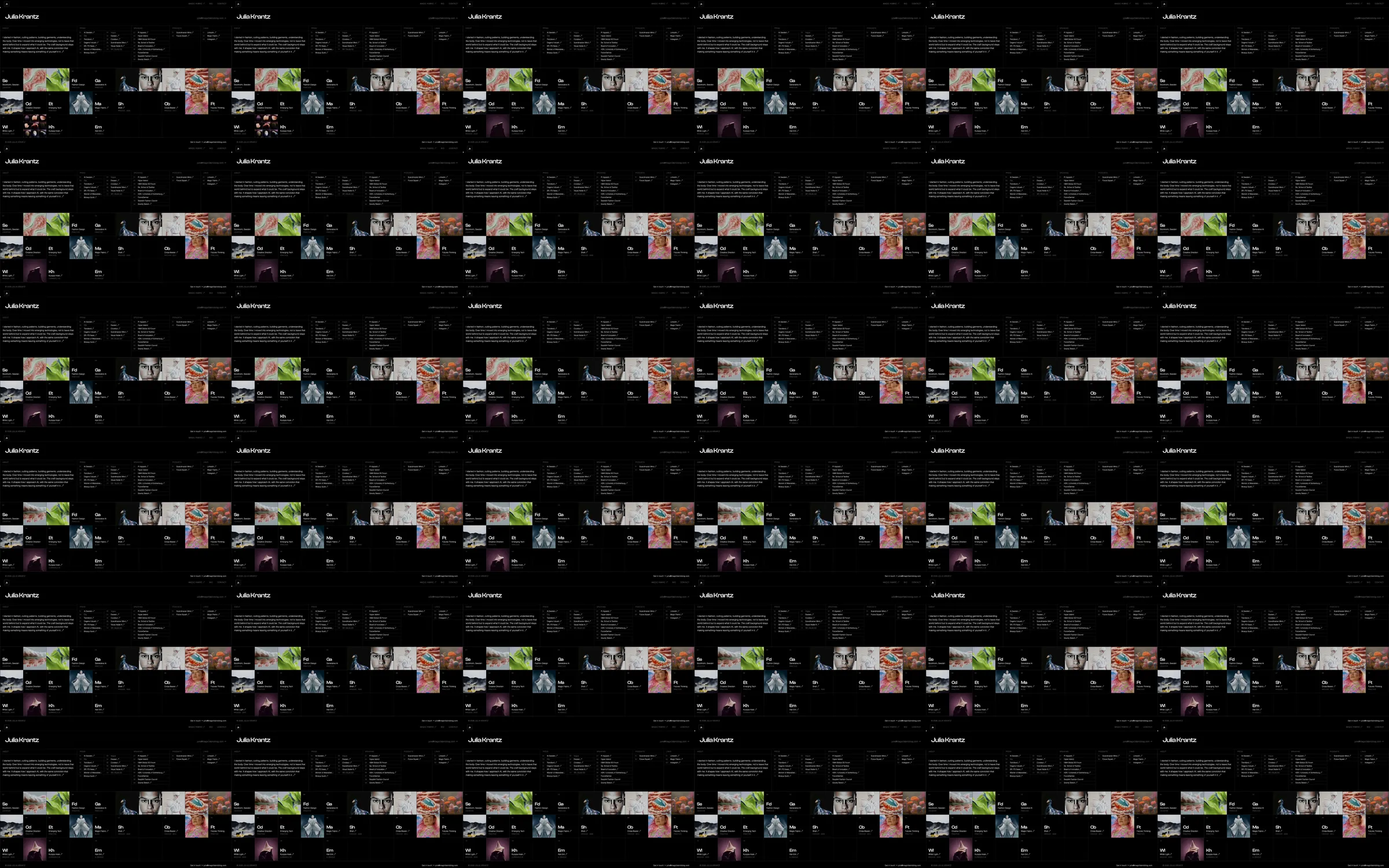
An almost-black portfolio treats the designer’s name, biography, location, disciplines and selected projects as a compact editorial index. Small image tiles and text-only cells share a fine-lined grid, making emerging-technology work feel like a browsable archive rather than a sequence of large marketing sections.
1. Compact name and navigation. 2. Biography and discipline index. 3. Location and project labels. 4. Mixed image and text project grid. 5. Contact and footer information.
The quiet header gives the project grid ownership of the page. Mixing captions and photographs in one grid supports quick comparison, and fine rules maintain structure without visually heavy cards.
Refero [style page](https://styles.refero.design/style/92857b05-1c01-4c7a-b196-beb4e4871998) and [recorded video](https://images.refero.design/styles/refero.design/video/39e5f264-c5d5-4ea3-bd7a-0f0bd48e9e77.mp4); [live site](https://juliakrantz.com/) checked on 2026-10-05. The recording is a point-in-time reference; current site content may differ. Descriptions distinguish the recording from the current page where they differ. Layout and motion notes come from sampled recording frames and automated live captures; interactive controls were not comprehensively tested. Fresh mobile evidence stacks the biography above narrow image-grid columns. The desktop recording is a limited static-view reference.